Address:
1110 Lakeshore Road West - The farm manager's home and gatehouse to Lisonally Farm
Summary:
Lisonally Farm was the summer estate of Sir Frank Baille and his wife Lady Edith Baille.
Property Details:
Those who have travelled along Lakeshore Road west of Fourth Line over the years are likely familiar with a brown shingled cottage with a large green roof, sitting on an angle to the road. Located at 1110 Lakeshore Road West, the house was accompanied for many years by a small 'gnome house' in a tree stump and a carved wood bear standing sentry outside the house. What many people may not know is that this unassuming building was once the farm manager's home and gatehouse to the historic Lisonally Farm.
Lisonally Farm was a summer estate purchased by financier and industrialist Sir Frank Baillie and his wife Lady Edith Baillie in 1917. In 1921, after Sir Frank’s death, Lady Edith redeveloped the estate to be a fully functioning farm. She hired Toronto architecture firm Page & Warrington to design several new buildings, including the Farm Manager’s Cottage, finished in 1926. Structures were constructed out of stone and wood in the Arts & Crafts tradition using natural and local materials. The Arts & Crafts style was developed as a reaction to the mechanization and dehumanization of the Industrial Age, and attempted to reconnect people to nature and handcrafted elements. This aesthetic and lifestyle was exactly what Lady Edith was promoting at Lisonally Farm.
The Farm Manager’s Cottage is a humble yet eloquent example of the Arts & Crafts style. It was constructed using local, natural materials including stained wood shingles and Credit Valley stone taken from the nearby ravine. The low sloped roof, tapered stone piers on the corners and natural wood windows and trim work connect the building to its natural surroundings. The cottage displays early 20th century craftsmanship that is visible in the stone piers, stone chimneys and hand-built wood windows.
A well-respected philanthropist, Lady Edith’s approach was to grow produce and raise livestock that could provide food and income for local hospitals, institutions and charities. The farm had stables, a dairy, piggery, poultry house and numerous orchards and gardens. She and her farm manager, Mr. Petrie, also started a reforestation plantation, growing hundreds of native trees such as spruce, maple, birch, hemlock and elm.
The estate remained in the Baillie family, but it was subdivided in the 1970s and most of the original buildings were torn down. The cottage remained on a separate parcel and was listed on the Oakville Heritage Register in 2009. In 2020, the family decided to sell this remaining parcel, and many assumed the building would be demolished. Luckily for this historic gem, the property had some heritage protection through the town, and through its new owner, Jennifer Kravis, the great-granddaughter of Sir Frank and Lady Baillie. Jennifer and her husband Nils decided the building was too important to lose and embarked on a four-year journey to restore the building and construct a new addition.
The renovations are now complete and the original cottage, which once faced inwards towards the original laneway of the farm, now sits with its front door facing Lakeshore Road. New cedar shingle cladding has been installed and the historic stone pillars and chimneys have been renewed. The original wood windows and front door were even restored by owner Nils who took a heritage restoration course to undertake the work. New wings to the side of the original building accommodate additional living space and an attached garage. The building has been lovingly restored and rehabilitated so that it has another century of life ahead.
Lisonally Farm was a summer estate purchased by financier and industrialist Sir Frank Baillie and his wife Lady Edith Baillie in 1917. In 1921, after Sir Frank’s death, Lady Edith redeveloped the estate to be a fully functioning farm. She hired Toronto architecture firm Page & Warrington to design several new buildings, including the Farm Manager’s Cottage, finished in 1926. Structures were constructed out of stone and wood in the Arts & Crafts tradition using natural and local materials. The Arts & Crafts style was developed as a reaction to the mechanization and dehumanization of the Industrial Age, and attempted to reconnect people to nature and handcrafted elements. This aesthetic and lifestyle was exactly what Lady Edith was promoting at Lisonally Farm.
The Farm Manager’s Cottage is a humble yet eloquent example of the Arts & Crafts style. It was constructed using local, natural materials including stained wood shingles and Credit Valley stone taken from the nearby ravine. The low sloped roof, tapered stone piers on the corners and natural wood windows and trim work connect the building to its natural surroundings. The cottage displays early 20th century craftsmanship that is visible in the stone piers, stone chimneys and hand-built wood windows.
A well-respected philanthropist, Lady Edith’s approach was to grow produce and raise livestock that could provide food and income for local hospitals, institutions and charities. The farm had stables, a dairy, piggery, poultry house and numerous orchards and gardens. She and her farm manager, Mr. Petrie, also started a reforestation plantation, growing hundreds of native trees such as spruce, maple, birch, hemlock and elm.
The estate remained in the Baillie family, but it was subdivided in the 1970s and most of the original buildings were torn down. The cottage remained on a separate parcel and was listed on the Oakville Heritage Register in 2009. In 2020, the family decided to sell this remaining parcel, and many assumed the building would be demolished. Luckily for this historic gem, the property had some heritage protection through the town, and through its new owner, Jennifer Kravis, the great-granddaughter of Sir Frank and Lady Baillie. Jennifer and her husband Nils decided the building was too important to lose and embarked on a four-year journey to restore the building and construct a new addition.
The renovations are now complete and the original cottage, which once faced inwards towards the original laneway of the farm, now sits with its front door facing Lakeshore Road. New cedar shingle cladding has been installed and the historic stone pillars and chimneys have been renewed. The original wood windows and front door were even restored by owner Nils who took a heritage restoration course to undertake the work. New wings to the side of the original building accommodate additional living space and an attached garage. The building has been lovingly restored and rehabilitated so that it has another century of life ahead.
Click to Enlarge
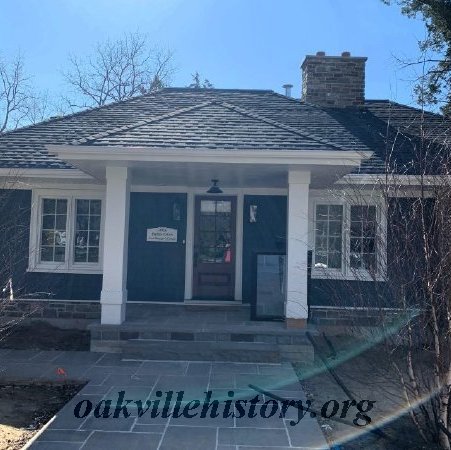 Farm Manager's House - 1110 Lakershore Road West
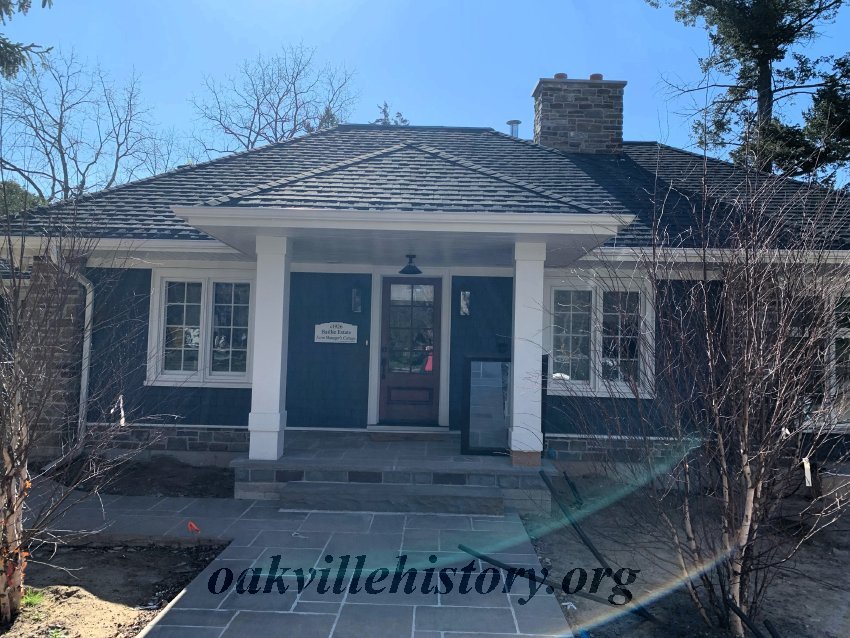 Farm Manager's House - 1110 Lakershore Road West